
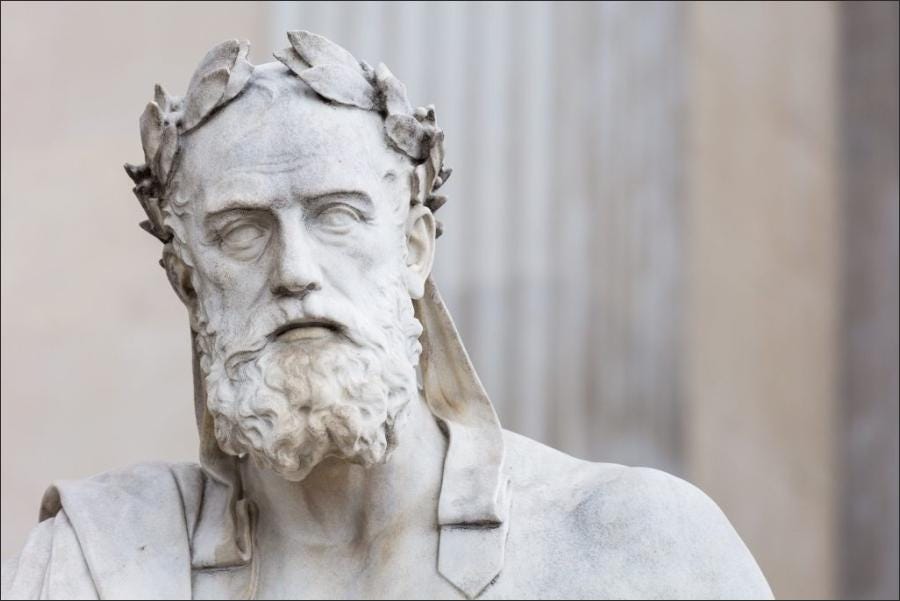
He no longer makes any use of persuasion but bulls his way through every situation by force and savagery like a wild animal, living in ignorance and stupidity without either rhythm or grace.
In what may appear to be a bit of a departure from the central theme of a project called Plato’s Barbell, Plato himself, through his trust mouthpiece, Socrates, unintentionally offers us an approach to the sport that most of this book seems to argue against: that the surest path to weightlifting success is a complete disregard for any academic undertaking not related to the sport itself.
Where cautious and conservative or holistic and well-rounded are fine approaches to many an endeavor, the acquisition of the savage strength required to win gold is not such an endeavor. This idea is not so much a hard and fast rule as it is an ongoing observation. When observing the strongest men and women in the world actual training philosophies and programming theories may vary. One constant, however, is invariably present in each and every athlete: a noticeable focusing on nothing other than the task at hand.
In Book III of Plato’s Republic Socrates discusses with Glaucon the values and drawbacks of various approaches to education. Socrates and Glaucon agree that those who are naturally well endowed in body and soul are better off than those whose bodies are naturally unhealthy or incurably evil. They further agree that a person who pursues an education in music and poetry in moderation will pursue physical training in moderation as well. Such individuals will work at physical exercise to arouse their spirited nature rather than to acquire the sort of physical strength for which athletes labor.
To prove his point Socrates asks Glaucon if Glaucon has noticed the effect that a lifetime of physical training has on a person when not rounded out by music or poetry and, conversely, a lifetime of music and poetry when not balanced with physical training. When Glaucon asks Socrates to explain, Socrates argues that a dedication to physical training, without being moderated by the arts, leads to “savagery and toughness” while the opposite life leads to “softness and overcultivation.”
I learned about the art of weightlifting in the back of a dusty granite shop in an industrial strip mall in Southern Nevada. I was never in the gym to become a world champion or an Olympian but, to a man, everyone else there was. I was surrounded by some of the best lifters and smartest minds in the sport and I soaked up every piece of data that flew my way. There was no music. There was frequently very little conversation. There were only Ironmind VHS tapes and training hall videos played on repeat.
After a few years immersing myself in the world of barbell sports in various gyms, competitions, and seminars I realized that among the many differences between the sort of top-tier athletes from that dusty old off-the-beaten-path gym and the average barbell lifter, one crucial difference mattered more than any other: not only did the top athletes want championship level strength more, they had no reservations about getting it. This is not to say that every rep and every set the top-level athletes performed was designed to go 100%. Nor is it true that the average lifter does not sometimes give 100% to his or her movements. But it is to say that every workout at the highest level is designed for a specific reason: to acquire a strength unattainable by giving anything less than 100%. To that set, that rep, that sport as a whole.
Approaching any single rep of any single set without that 100% mindset is a sure-fire approach to ensuring mediocrity. And no savagely strong strength athlete has any regard for mediocrity.
They have one goal and one goal only, and that goal is incompatible with many of the most popular approaches to strength training. Instead of going to a gym to get stronger, the strongest go to the gym to get as strong as possible, period.
This idea may seem self-evident but consider your average trip to your local globo-gym or barbell club. How many people there are there to get stronger? And how many people there do you truly believe are there to get as strong as possible? That noticeable, but probably not obvious difference explains the entire chasm between the strong and the savagely strong.
There is no conservation.
There is no caution.
There is no moderation.
Every workout is designed for one purpose and one purpose only: to ensure that, at the end of the day, there is nothing the strongest did not do to get stronger than everybody else.
This is precisely the sort of all-in approach to physical training Socrates and Glaucon refer to when they agree that “those who devote themselves exclusively to physical training turn out to be more savage than they should.” This “source of savageness is the spirited part of one’s nature. Rightly nurtured it becomes courageous, but if it’s overstrained, it’s likely to become hard and harsh.”
When it comes to living a well-rounded life full of poetry, art, and overall fitness, hard and harsh are adjectives to be avoided. But if the goal of any athlete is to acquire championship level, untempered strength, then turning out to be more savage than one otherwise should is nothing short of Ideal.
 Plato's Barbell
Leave a comment