
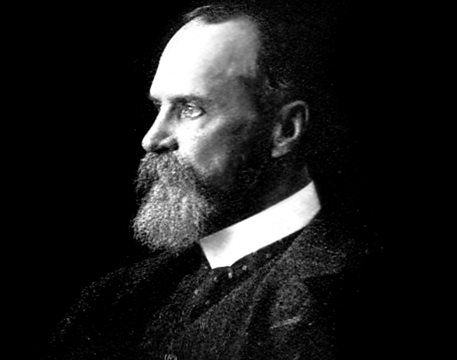
William James (1842-1910) was a Harvard trained physician (who never practiced medicine) who became America’s most famous philosopher and the first educator teach a formal psychology class. Despite these accomplishments James was stricken with what he called a “sick soul,” disproportionately focusing on human suffering. It was only after giving up medicine to focus on philosophy that James was able to cure that soul sickness, a career path James would admit was less intentional that it was inevitable.
James, as close to a philosophical genius as America had produced at that time, never formally studied philosophy in an academic setting. In his 1890 work Principles of Psychology James argues that “Genius, in truth, means little more than the faculty of perceiving in an unhabitual way.” Rather than shy away from his intellect so versed in various fields, James embodied another of his famous claims that “New truth is always a go-between, a smoother-over of transitions. It marries old opinion to new fact so as ever to show a minimum of jolt, a maximum of continuity.”
In this regard, William James never hesitated to follow the path down which the truth may lead him. “Instinct leads,” James said, “intelligence does but follow.”
Embodying this academic ethos, James was a pioneer in multiple academic fields. In addition to his claim that the first psychology class he taught was also the first one he ever heard, the New Yorker is also credited with developing a uniquely American (at that time) field called pragmatism. Pragmatism, so far as “truth” is concerned, views “the true” as “the name of whatever proves itself to be good in the way of belief, and good, too, for definite assignable reasons.” James’s view of pragmatism holds that “Ideas…become true just in so far as they help us to get into satisfactory relation with other parts of our experience.”
Oversimply stated, for James, that which is true is that which works. And new truth is that which carries us from accepted knowledge to novel knowledge. In our world, if training five times per week maximally improves our performance then it is true that training five times per week is the way to maximally improve our performance. It can also be true, however that some new discovery may come to light that shows that training four times per week turns out to be more efficient than training five times per week. In their own times, each training frequency being the most efficient is “true” because that is what works the best. And going from five to four times per week simply requires a “new truth.” This application of James’s pragmatic view of truth may seem obvious enough but when applied more tenuous claims the view is less apparently accurate.
Can we say, for example, that always snatching before clean & jerking in our training sessions is the optimal order in which to perform the two platform movements? Is benching, then squatting, then deadlifting the similarly optimal order for powerlifting’s Big 3? We (mostly) believe it is because that is the conventional knowledge. That knowledge, we believe, is based on decades of empirical data provided by the trials and errors of countless athletes and coaches that have gone on before us. At some point, we feel, there is no need to reinvent the barbell by clean & jerking before snatching or deadlifting and squatting before benching. Sometimes that’s just the way it is done really is a good enough reason for continuing to do what has always been done, but only when going back in history far enough shows that it has not actually always been done that way but, instead, was the way arrived at by way of theory and practice.
Fortunately (or unfortunately depending on our attitudes toward philosophical investigation) William James provides a sort of fatalist argument when he suggests that “The truer is the one that pushes farther; so we are ever beckoned on by the ideal notion of an untimely satisfactory terminus.” By this James means that the one who most aggressively seeks the truth is the one who dares to follow that investigation wherever it may lead until, finally, there is no more to investigate.
In the example above, it is likely that the conventional views of training movement orders are the truest truths discovered at the end of the investigative tunnel by those athletes and coaches who pushed further, lifted heavier, and exhausted themselves physically and academically until they determined that any other order of movement was a sub-optimal way to train for white lights and gold medals.
But the same may not be true of other conventional knowledge in weightlifting, powerlifting, or other strength sports arenas. So, while we may not possess genius level intellects like William James, we would all serve ourselves and our endeavors a bit more faithfully if we were to similarly chase down the truth whatever that may require. Thinking outside the box is a worthwhile pastime. Building your own boxes and filling them to the brim with research, experiment, and failure until you climb atop them in order to reach the ultimate truth is another entirely.
 Plato's Barbell
Leave a comment