
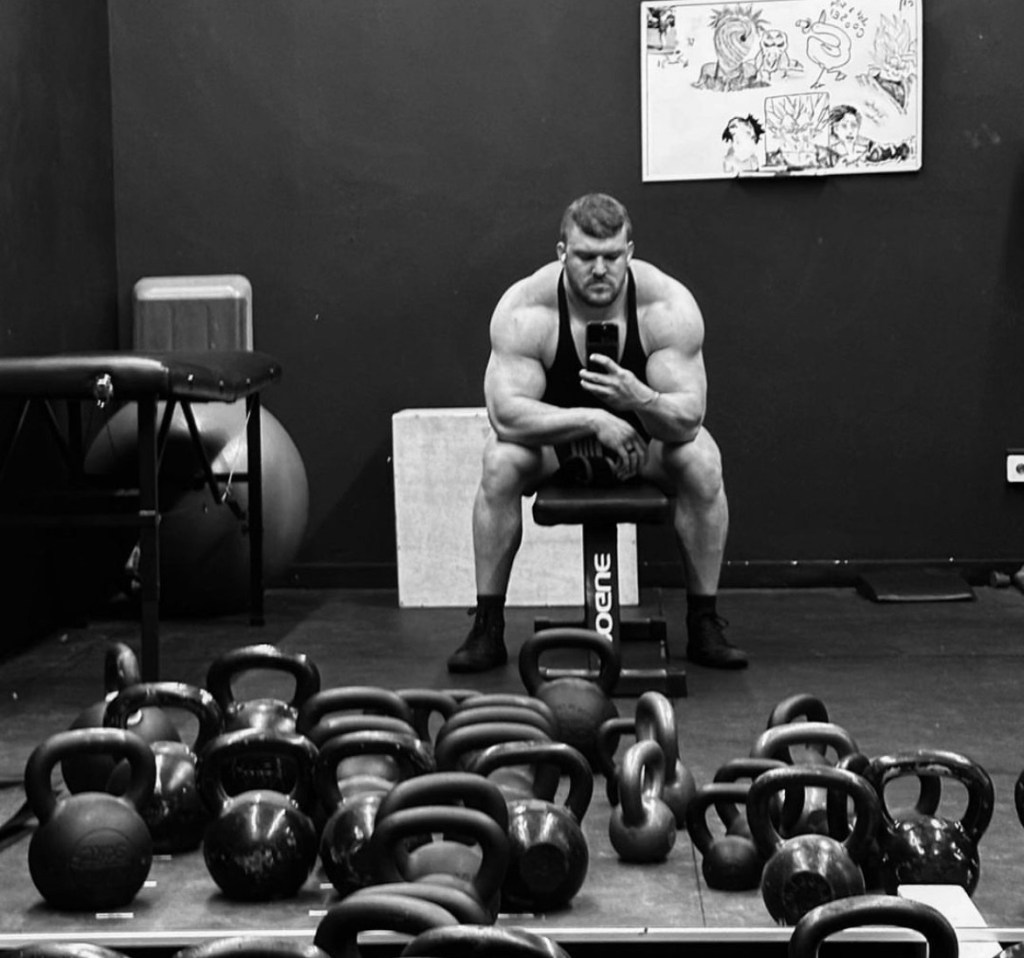
Conner, you’re on The Platform with Plato’s Barbell. Welcome! Can you give us a little rundown on your background?
Thanks for having me! I’m 28 years old from a small town on the Indiana border called Sturgis, Michigan. I graduated from Sturgis High school in 2014 and then moved to Kalamazoo to attend Western Michigan University to study exercise science, after a few semesters of that I switched to business. While in school I started working at a fitness equipment and supplement store called One On One fitness. I ended up managing that store and leaving school behind for awhile. I loved working at the store a lot more than going to school. However, after meeting my wife, I decided to go back and get a degree. Now I’m a full-time life insurance broker. Athletically I was known as a football player growing up until I discovered bodybuilding. I had done a few unsanctioned charity powerlifting meets while learning to train with some local powerlifters/strongmen. However, my overall goal initially was to be a bodybuilder and I competed under coach Justin Harris in 2017. I was proud of the physique bodybuilding brought but unexpectedly I had a surge in strength after the show that brought me back to powerlifting. I started winning cash prize meets, totaling 1931 at a 214 body weight and getting (at that time) the 2nd highest all-time full power bench press in the JR 220 class. Since then it’s been all powerlifting for me. This last year I took off to get that degree but am excited to get back on the platform soon.
Your social media reflects a long history of interest in both strength sports and philosophy. Have these two seemingly disjointed fields always overlapped for you?
Yes they have. However, I didn’t think of it as “philosophy.” If you look at one of my pinned posts you can see me training in my dad’s basement home gym as a young teen. He had various posters on the wall, some professionally made while others were typed up by him with quotes that he connected with. One read “there is no finish line,” referencing how fitness is a lifelong pursuit. There was another poster with a Frank Zane quote “The path is the goal.” This ties in with one of the early themes of your book. Is it better to compete against yourself or your peers? The philosophy my father embodied is that the ultimate adversary is yourself and in the pursuit of bettering yourself you may very well progress past your peers. There were other quotes on the walls as well like Vince Lombardi’s famous “winning is a habit” speech that echoes Aristotle. At the time however, I never thought of it as philosophy, now looking back it obviously was.
You’ve got a popular video online showing you benching in the basement gym you mentioned that highlights how far you have come since you first learned to bench press. Has your interest in philosophy helped shape the athlete you’ve become? If so, how?
I could write pages answering this question. My interest in philosophy has absolutely shaped the lifter I am. As a high school student I fit the “angsty teen” stereotype as I held different values than a lot of my peers. That lead to rejection from the girls at my school and a rift between myself many of the guys. It also led me to quitting the football team even though it was believed I could’ve played college ball (not for a big school, I wasn’t THAT great.) I gave up football to pursue bodybuilding and, in a small rural Michigan town, that’s a big deal. For a number of reasons, I felt drawn to the iron. I’m sure part of it was the fact that I love physically exerting myself and training has always been a cathartic experience, but there were other variables at play. Training didn’t make me “happy” in the laughing or smiling sense; it left me feeling fulfilled. That highlights the observation that there’s a difference between pursuing something fulfilling (meaningful) and pursuing things that make you temporarily happy. And if training gave me meaning, well does that trivialize what “meaning” is? Is bodybuilding too trivial a pursuit to give meaning, or do we determine our own meaning? These were questions that inevitably arose in my pursuit of gym related goals. I also had good mentors around me that were Christians. Although there is a distinct difference between religion and philosophy they both seek underlying truths in principles that reflect reality. For me these deeply religious men at my hometown gym helped shape my mental framework to hold internal philosophical dialogue later in life. Since then my motivations and beliefs have changed, but philosophy (or just thinking critically about the why behind what I do) plays a major role and my relationship with the gym has evolved. Philosophy helps anyone (including me) self analyze and assess themselves in all manner of things including the gym.
How do you feel philosophy can help athletes improve their performance, regardless of which specific sport they play?
To quote the Book of Five Rings “when you see the way broadly you will see it in all things.” Philosophy, science, and religion all have the same aim: to discover what is true. They all take different angles at attempting the same goal. When you pursue philosophy and you pursue truth, you are better able to recognize patterns in relationships with progress in the sport you’re participating in, and also in yourself. It allows universal laws of reality to be better applied to the pursuit of mastery of whatever craft you’re attempting. It is possible to be a great athlete without wielding the power of philosophy. It is impossible, however, to be the best athlete you could possibly be without applying every tool at your disposal toward your craft, and thinking philosophically is one of these tools.
If you could spend a training session working out with any philosopher in history, who would it be and what would you ask them about between sets?
I think if we can count Miyamoto Musashi as a philosopher he would be interesting to train with. I would ask him to further articulate to me the mindset he gets in before one of his famous duels. The writing we have from him is not too different from “The Void” Dave Tate talks about that many lifters have experienced:
“Both in fighting and in everyday life you should be determined though calm. Meet the situation without tenseness yet not recklessly, your spirit settled yet unbiased. Even when your spirit is calm do not let your body relax, and when your body is relaxed do not let your spirit slacken. Do not let your spirit be influenced by your body, or your body be influenced by your spirit.”
Although my pursuit of powerlifting doesn’t involve killing anyone like a samurai would, there are undoubtedly parallels in what goes on in many great lifters’ minds as they approach a loaded barbell just moments before pushing their body to the limit. I think there could be more to learn from one of the greatest swordsmen to ever live.
Of all of the motivational quotes you have posted over the years which, if any, runs through your mind when you’re about to step onto a platform and why?
There are a few that I use, although it may not be obvious why they hold weight without explanation. One is from a film called “The Grey” that goes “Once more into the Frey, into the last good fight I’ll ever know, live and die on this day, live and die on this day.” Without spoiling the movie the protagonist recites these words multiple times throughout the movie and reveals that they were a poem written by his alcoholic father. The final time he says this quote he’s quite literally staring down what he can assume to be his death, and decides to fight back rather than accept his fate. The film is about finding meaning in suffering and contains allegories meant to reflect the human spirit as it encounters hardship.
I currently make decent money, I have a lovely home with a devoted wife. I have a good life…but this has not always been the case for me. There have been times when all I had was the iron. This quote takes me back to when it was up to me to rise above all that adversity and push beyond. This quote reminds me of times when my back was against the wall and I had to either fight or die. (In a less literal sense than the movie, but still.)
Finally, what are you reading now and what is next up on your bookshelf?
Right now I’m changing things up and reading a fictional book with my wife called Iron Flame. Next up is Plato’s Barbell and some Jailhouse Strong works as well as a book written about the memoirs of Ulysses S. Grant. Some of my favorite all-time books with regard to philosophy and bodybuilding would be Meditations by Marcus Aurelius and The Education of a Bodybuilder by Arnold Schwarzenegger.
Where can people find you online and what sort of endeavors are you working on that fans might want to pay attention to?
Right now I’m in the midst of coming back to the sport of powerlifting under coach Josh Bryant. I took over a year off to go back to university, get married, and get over an injury. Now I’m feeling good working with Josh and ready to break new ground with new styles of training. Other than that I’m working on my career as an insurance broker to put my wife through chiropractic school. Between those two things I’m pedal to the metal seven days a week!
And the best place to find me is my Instagram, @conneryoung28.
Thank you for taking the time to join us on The Platform! And thank you for helping promote the evolution of the role of philosophy in the strength sports world!
 Plato's Barbell
Leave a comment