
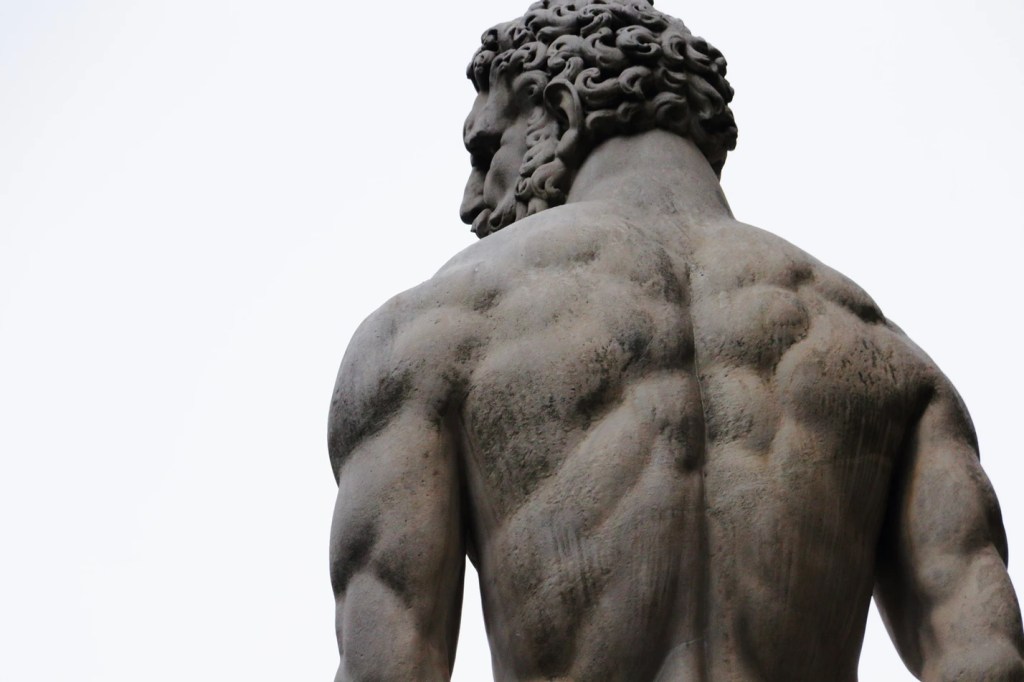
In what may be the most philosophical (and certainly the most poetic) way to say so, Seneca the Younger reminds us that there are no excuses and there never have been. In the first century AD Seneca the Younger wrote the Roman Era tragedy of a Greek hero, Hercules Furens (The Mad Hercules). In Hercules Furens the Stoic relays his philosophical version of the story of an ancient hero known typically for his physical strength and toughness. In ancient mythology Hercules was so beloved for his might and courageousness that, upon his death, he was brought to Mount Olympus to live among the gods. But Seneca provides an alternative, and arguably more instructive, version that translates perfectly to how we should approach strength sports.
Where most stories of Hercules focus on his adventurousness, physicality, and rage, Seneca’s story highlights the hero’s mental and emotional determination. Upon killing Lycus, the tyrannical King of Thebes, Hercules becomes mad, killing his own wife and children before falling into a deep slumber. Upon waking, Hercules learns what he has done and prepares to kill himself. Amphitryon, son of King Alcaeus, and Theseus himself convince Hercules to instead continue living and seek atonement for his sins.
Although the 12 Labors, to which Hercules was sentenced and for which he is most famous, included killing, capturing, and performing seemingly impossible tasks, Seneca’s story demonstrates a level of toughness touched upon, but not highlighted, in the others. Pulling barbells off the ground, thrusting dumbbells into the air, rowing long distances, and sprinting faster than should be humanly possible all appear on the surface to be tasks as similarly physical to killing a Nemean Lion or capturing the belt of the warrior Queen Hippolyte. But in his version of the Hercules tale Seneca shows us something different.
Where the other Herculean historians knew the stories of physical accomplishments would garner much adoration given the mythical hero’s godlike status, Seneca chose to reframe the story in his own stoic sensibility. Seneca, one of the pioneers of stoicism, wrote extensively on ethics, basing much of his moral philosophy on Stoic doctrines. This story of Hercules means to show that where there are many things we can control, there are some we cannot. And even if that which we cannot control is extraordinarily life-altering and tragic, letting such circumstances control us is quite simply unacceptable. Hercules killed his family in a fit of madness, by his own hand but not by his own accord. It is only what happens when he snaps out of his slumber that Hercules can control.
Similarly, there is a lot an athlete is able to control and, ultimately, every made and missed lift is up to the athlete and no one else. But during those periods of disgust and agony when the three white lights were at your fingertips and just managed to turn red by a matter of degrees or inches, it is how you pick yourself up, dust the chalk off, and move onto the next rep that determines whether you live or die. Like Seneca teaches us, this is what made Hercules a legend. So while what stands between us and victory may seem insurmountable, like Hercules, we must find a way. Or make one.
 Plato's Barbell
Leave a comment